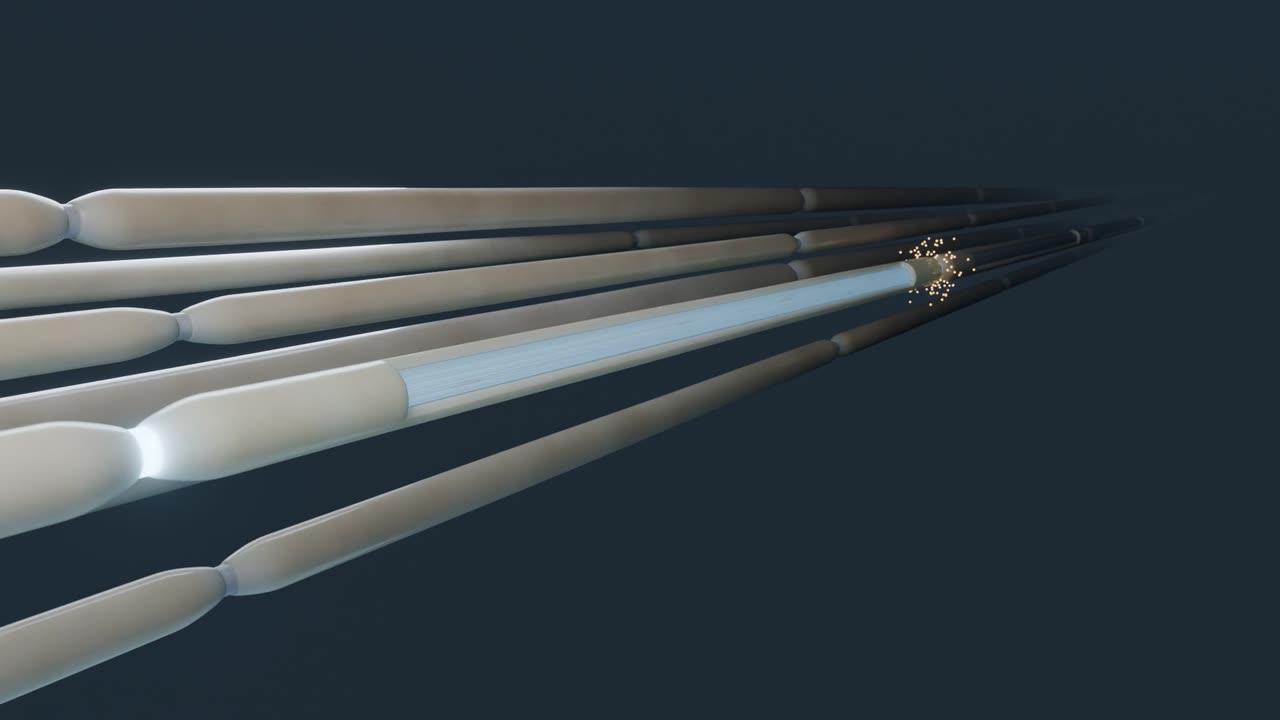
A rendered film. The scene that rendered it comes with Pro or Lifetime.
Saltatory conduction
The camera tracks along a myelinated fibre with its sheath cut away while five nodes of Ranvier fire in turn: after each peak a faint depolarisation fills the next internode, the next node charges to threshold, and Na+ ions stream in as it flares.
Sources
- Huxley and Stämpfli 1949
- Rushton 1951
- Waxman and Ritchie 1993
- Salzer 2003, Neuron 40:297
- Kandel, Principles of Neural Science, chapter 9
- Hursh 1939 (internode to diameter ratio)
- Friede 1972 (internode to diameter ratio)
Rendered in Blender Cycles from code: geometry, materials and motion.
Exaggerated or simplified
- Internodes are compressed about 3.3 times (30 times the fibre diameter instead of about 100) so several jumps fit in the shot.
- Time is slowed about 50,000 times and the steps run one after another (spread, charge, upstroke); in a real fibre the next node is already rising while this one peaks, and the impulse spans many nodes.
- The dim glow under the myelin stands for passive spread of current; Na+ ions are hugely oversized and drawn only at the firing node, and potassium outflow is left out.
- Cytoskeletal strands are about 5 times too thick and far too few, and the slot cut in the myelin is an illustration device.