A rendered film. The scene that rendered it comes with Pro or Lifetime.
Chemical synapse
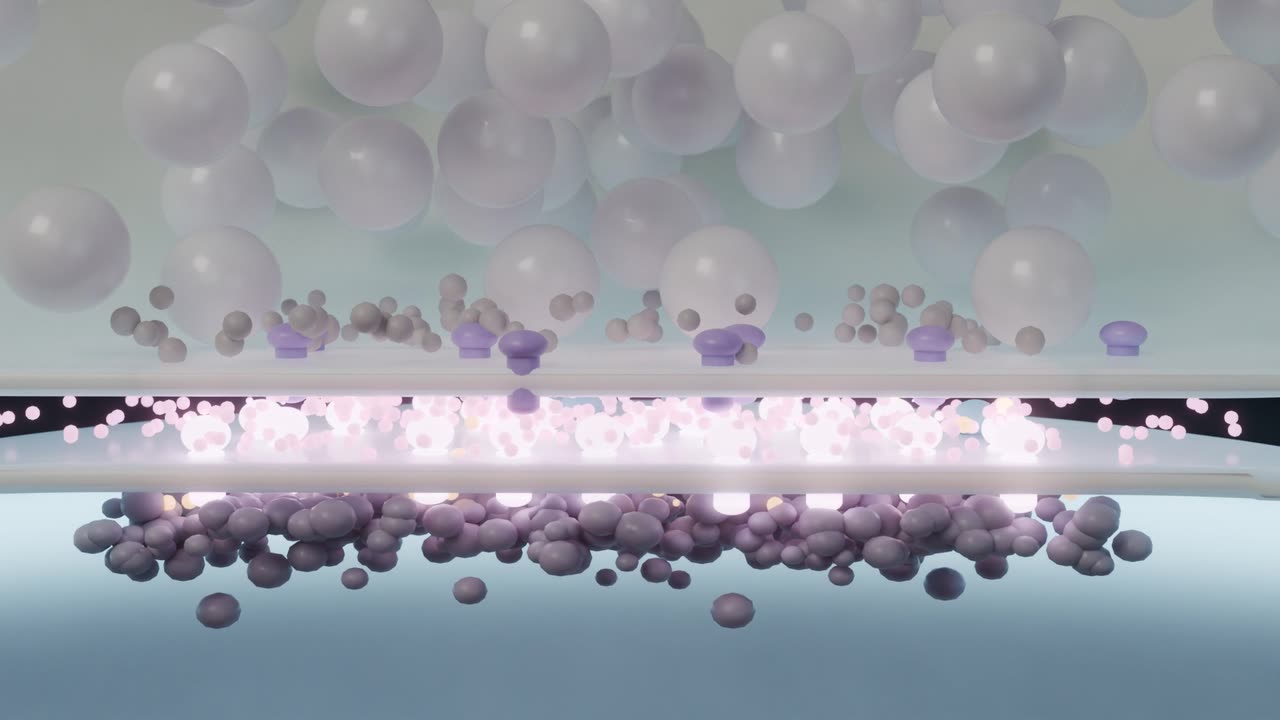
A cut-open bouton and spine head: the camera pushes in to the active zone as an action potential arrives, calcium channels open, three vesicles fuse and release transmitter across the cleft, receptors open to let Na+ in, and a depolarisation spreads over the spine.
Sources
- Südhof 2013, Neuron 80:675 (neurotransmitter release)
- Harris and Weinberg 2012, Cold Spring Harbor Perspectives in Biology (ultrastructure of synapses)
- Kandel, Principles of Neural Science, chapter 15
- Sheng and Kim 2011 (postsynaptic density)
Rendered in Blender Cycles from code: geometry, materials and motion.
Exaggerated or simplified
- Membranes are drawn 9 nm thick; a real bilayer is about 5 nm.
- Ions and transmitter molecules are hugely oversized and far fewer (150 molecules per vesicle against several thousand), and Ca2+ and Na+ are drawn only near their channels, though they fill the fluid outside.
- Time is slowed about 10,000 times: real fusion and release take well under a millisecond, and the steps are shown one after another so they read.
- Receptors and calcium channels are generic types, and SNARE proteins, synaptotagmin, vesicle recycling and transmitter reuptake are not drawn.