A rendered film. The scene that rendered it comes with Pro or Lifetime.
Skin and wound healing
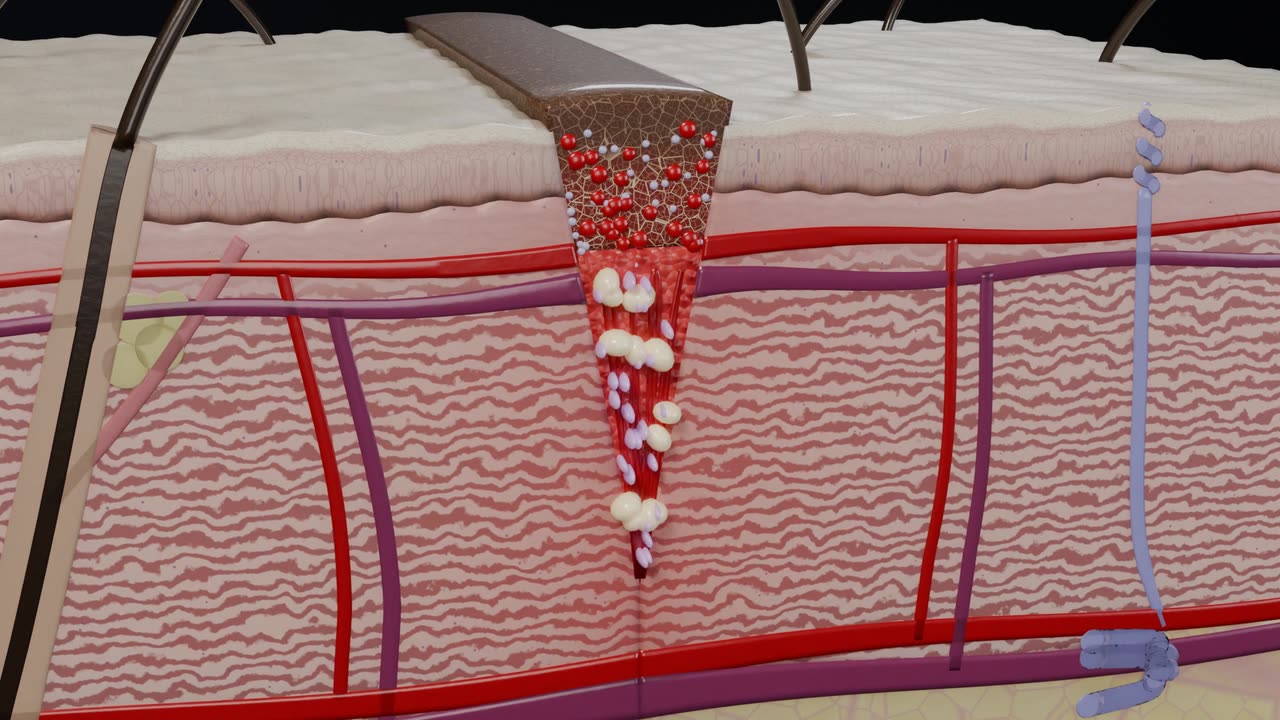
A cut-away block of skin shows its layers, hair follicle, sweat gland and vessels, then an incision opens and fills with blood, a clot and scab form, white cells move in, red granulation tissue fills the wound from the base, new skin grows in from both edges and the wound closes as a scar.
Sources
- Gurtner et al., Wound repair and regeneration, Nature, 2008
- Singer and Clark, Cutaneous wound healing, New England Journal of Medicine, 1999
- Ross and Pawlina, Histology, 8th edition, chapter 15 (integument)
Rendered in Blender Cycles from code: geometry, materials and motion.
Exaggerated or simplified
- About three weeks of healing are compressed into about 4.5 seconds, and months of remodelling are only hinted at by paler tissue at the end.
- New skin starts growing over the wound within about a day in reality, alongside inflammation; here it comes after the granulation tissue fills so each step reads on its own.
- The epidermis is about three times thicker than thin skin, and cells, vessels and ducts are enlarged (red cells about 3 to 5 times) so they read on screen; cells are drawn only on the cut face.
- The wound contracts about 25 percent within the shot, which really takes weeks, and the scab is left in place at the end though in life it falls off once the skin has closed beneath it.