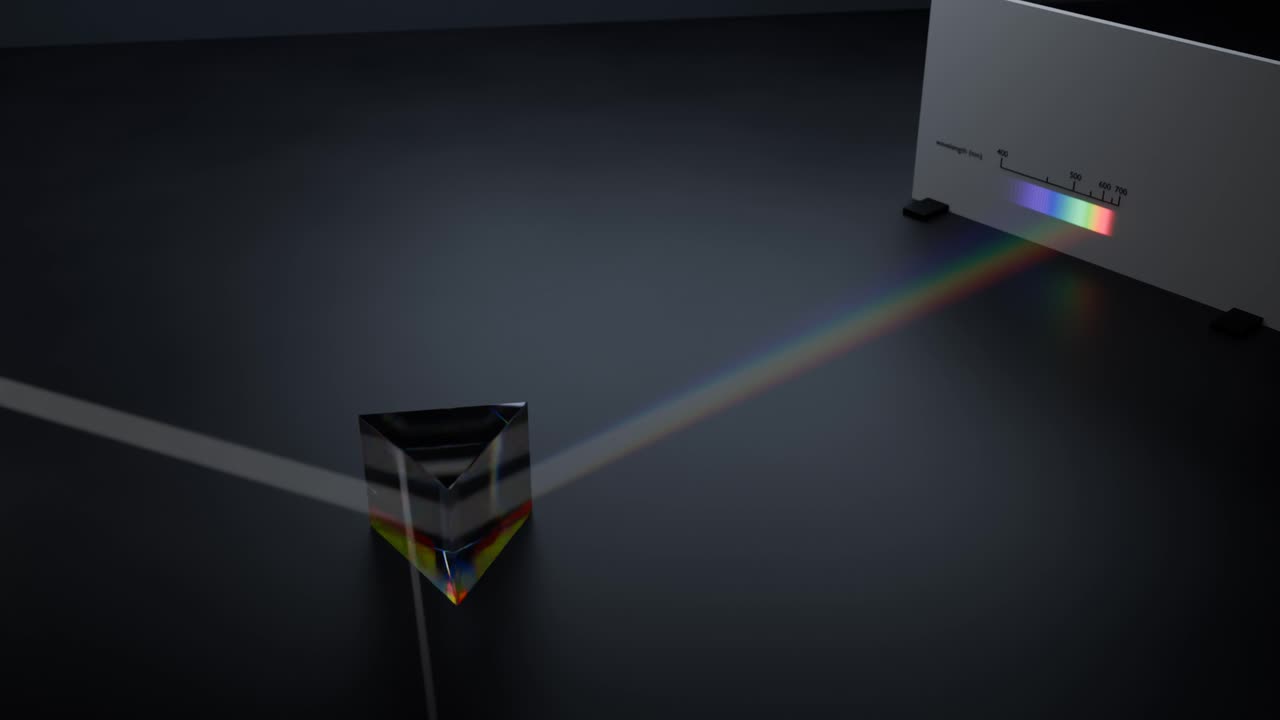
A rendered film. The scene that rendered it comes with Pro or Lifetime.
Prism spectrum
A narrow white beam crosses hazy air into a glass prism, fans out into colours with violet bent most and red least, and lands as a spectrum on a screen under a 400 to 700 nm scale as the camera moves from the prism to the screen.
Sources
- Schott N-SF11 catalogue Sellmeier coefficients
- CIE 1931 2-degree colour-matching functions (Wyman, Sloan and Shirley 2013 analytic fit)
Rendered in Blender Cycles from code: geometry, materials and motion.
Exaggerated or simplified
- The beam front travels at about half a metre per second so the eye can follow it; real light crosses the bench in about 4 nanoseconds.
- The beams are much brighter in the haze than real haze would make them; the haze is implied, not simulated.
- Polarisation is averaged and the faint internal reflections inside the prism are left out.
- The beam and spectrum colours come from a separate wavelength-by-wavelength trace, not from the renderer's own refraction.