A rendered film. The scene that rendered it comes with Pro or Lifetime.
Coronary blood supply
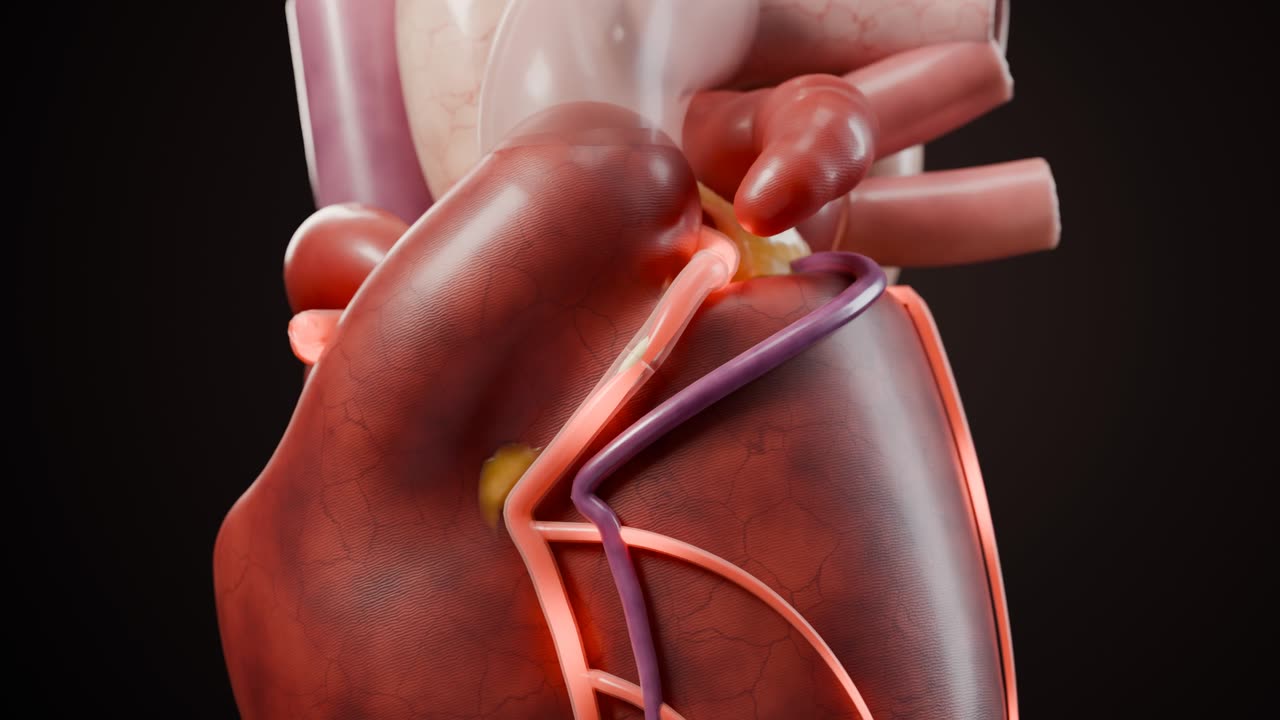
A beating heart seen from the front carries bright pulses from the aortic sinuses down its coronary arteries, then the camera pushes in on the LAD as a plaque narrows it and flow beyond it dims, and pulls back as the muscle that artery feeds turns dusky.
Sources
- Guyton and Hall, chapter 21 (coronary circulation)
- Gray's Anatomy
- Netter coronary plates
- Braunwald's Heart Disease (atherosclerosis, stenosis, LAD territory)
Rendered in Blender Cycles from code: geometry, materials and motion.
Exaggerated or simplified
- Plaque growth, which takes years to decades, is compressed into about 1 s, and the ischaemic colour change is compressed and stylised: real ischaemia does not show as a clean coloured region within seconds.
- The flow pulses are a visual code slowed 3 to 5 times from real coronary velocities (10 to 30 cm/s); brighter means more flow, not more oxygen.
- The arteries sit a little proud of the surface with less covering fat than a real adult heart, and their walls are see-through so the blood column shows; the pulmonary trunk is ghosted so the aortic root behind it can be seen.
- The left main artery is about 3 cm long (real 1 to 2.5 cm), and the ischaemic wall keeps contracting normally, where a real ischaemic segment moves less.
- The pericardium itself is not shown.