A rendered film. The scene that rendered it comes with Pro or Lifetime.
sp³ hybridization
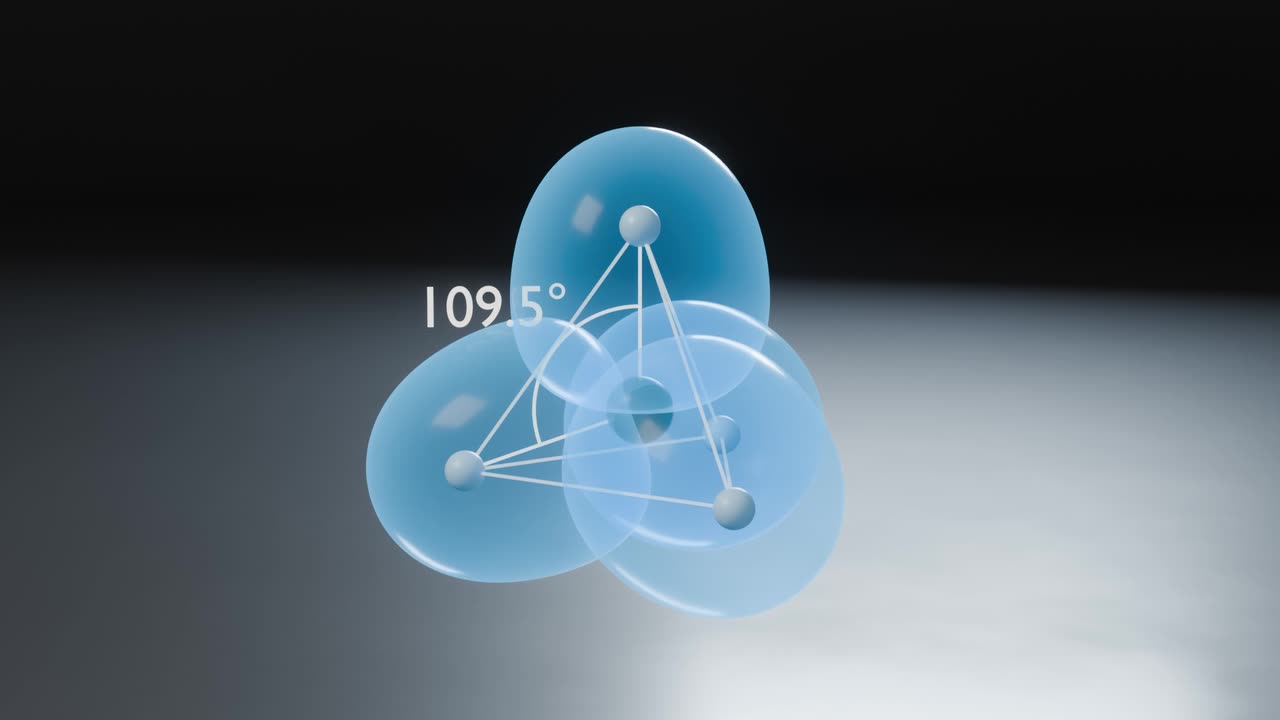
Carbon's 2s and three 2p orbitals appear, rotate smoothly into four equivalent sp3 hybrids, four hydrogens come in along the hybrid axes and merge with them into sigma bonds, and the camera ends square-on to a tetrahedron and a 109.5 degree angle arc.
Sources
- Pauling, The Nature of the Chemical Bond (hybridization, 1931)
- Atkins, Physical Chemistry, valence bond chapter
- Slater, Physical Review 36, 57 (1930)
- Hehre, Stewart and Pople, Journal of Chemical Physics 51, 2657 (1969) (hydrogen exponent)
Rendered in Blender Cycles from code: geometry, materials and motion.
Exaggerated or simplified
- The mixing of orbitals is a mathematical re-description of the same set of orbitals, not a physical process that happens in time; the total density never changes while the shapes do.
- This is the valence bond picture with a minimal basis; the molecular orbital description of methane gives the same total density but no localised hybrids.
- The 2s orbital is drawn without its inner radial node, which lies far inside the surfaces shown, and the promotion of an electron from 2s to 2p is not shown.
- The hydrogens flying in and the overlap switching on are animation devices, and the atoms are ball-and-stick spheres, not their real size.