A rendered film. The scene that rendered it comes with Pro or Lifetime.
Knee joint
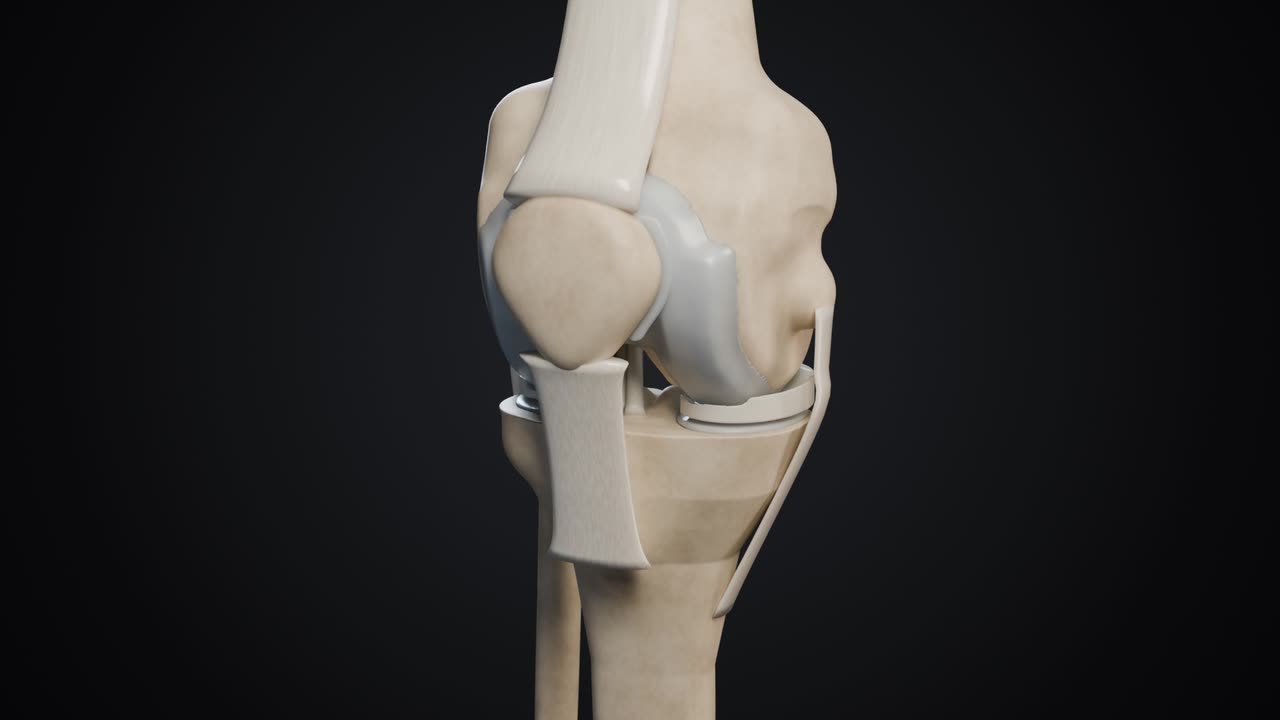
A right knee flexes from 0 to 90 degrees: from the front the patella slides down the trochlear groove, then a saw sweeps a sagittal cut as the camera swings to the medial side, and the section shows the femur rolling and gliding back on the tibia with the ACL and PCL in the notch.
Sources
- Eckhoff et al. 2007, JBJS-A 89 Suppl 3
- Freeman and Pinskerova 2005, J Biomech 38:197
- Iwaki et al. 2000, JBJS-B 82:1189
- Johal et al. 2005, J Biomech 38:269
- Pinskerova et al. 2004, JBJS-B 86:925
- Vedi et al. 1999, JBJS-B 81:37 (meniscal movement)
- Shepherd and Seedhom 1999, Ann Rheum Dis 58:27 (cartilage thickness)
- Amis and Dawkins 1991, JBJS-B 73:260
- Hollis et al. 1991
- Petersen and Zantop 2007, Clin Orthop 454:35
Rendered in Blender Cycles from code: geometry, materials and motion.
Exaggerated or simplified
- There is no joint capsule, synovium, fat pad or muscle, so the notch between the condyles, normally hidden, is shown bare.
- The femur is drawn vertical with no valgus angle, the tibia has no backward slope and its cartilage is flat.
- The menisci move as rigid pieces, horn roots included, where in life the roots stay fixed and the bodies deform; the cruciate bundles are straight tubes without fibre twist.
- The cut steps 2.5 cm further out through the lateral meniscus only, so its wedge profile shows, and the spongy bone pattern on the cut faces is a texture at about twice life size.