A rendered film. The scene that rendered it comes with Pro or Lifetime.
Kepler orbits
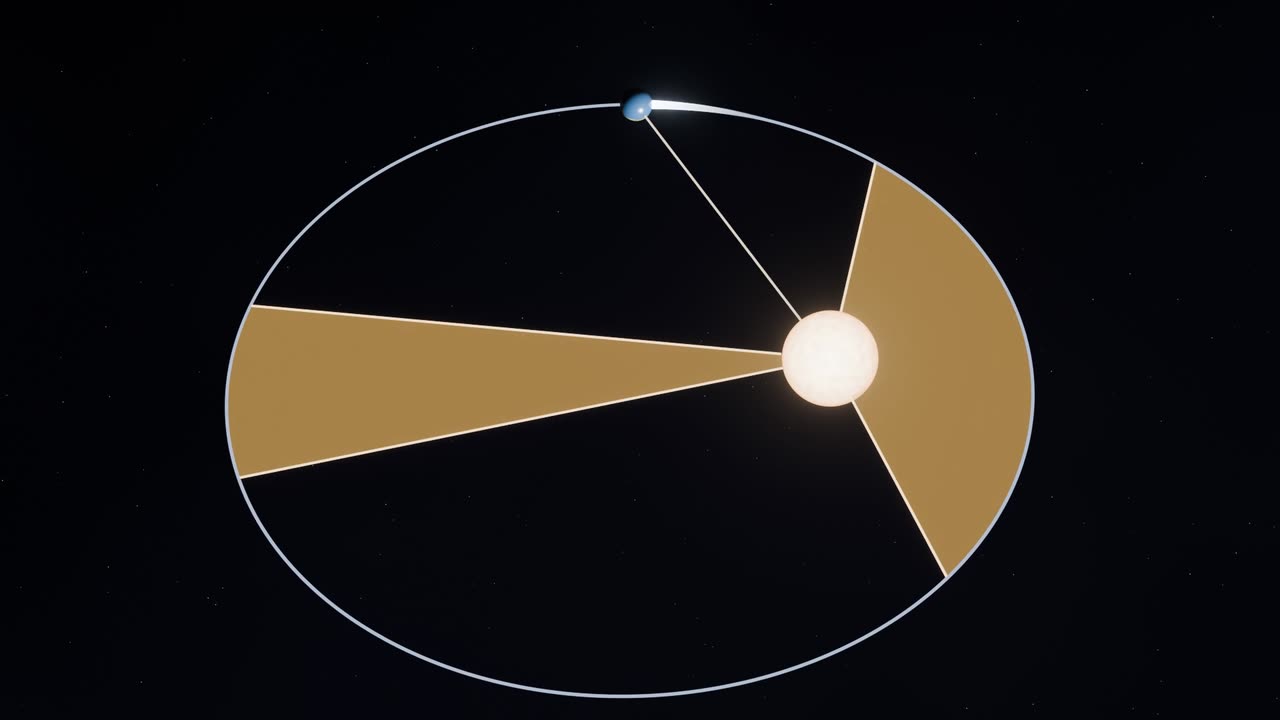
A planet orbits a star on an ellipse with the star at one focus, its trail lengthening as it speeds up near perihelion, while two wedges swept in equal times (long and thin at aphelion, short and fat at perihelion) brighten together to show their areas are equal.
Sources
- Kepler, Astronomia Nova (1609)
- Murray and Dermott, Solar System Dynamics, chapter 2
Rendered in Blender Cycles from code: geometry, materials and motion.
Exaggerated or simplified
- The eccentricity is 0.5 so the effect is visible; Earth's is 0.017 and Mercury's 0.206.
- The star and planet are drawn hugely oversized relative to the orbit, and one orbit takes 5 seconds.
- The star stays still; really both bodies orbit their common centre of mass, though for a much heavier star the wobble is negligible.
- The camera's tilt foreshortens both wedges by the same amount, so their areas stay equal on screen apart from a small perspective difference.