A rendered film. The scene that rendered it comes with Pro or Lifetime.
Hydrogen orbitals
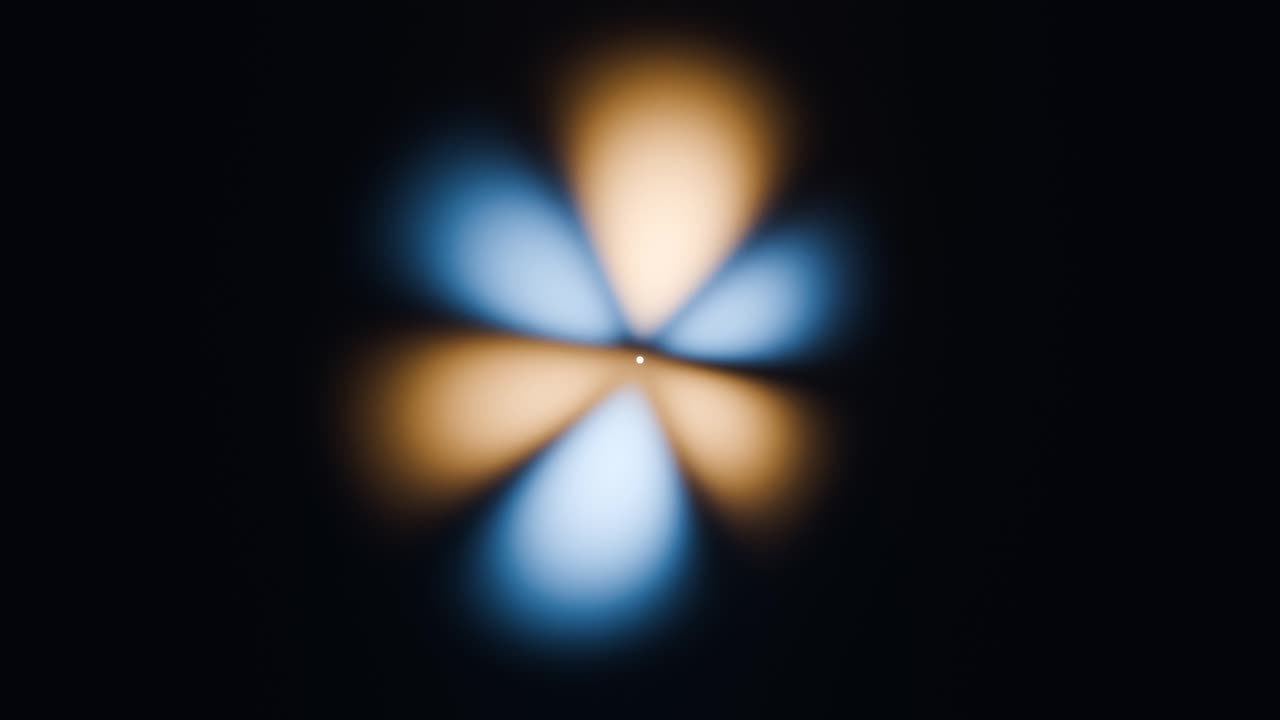
A hydrogen electron cloud morphs from 1s through 2p, 3d and 4f as the camera slowly orbits, then a plane slices away the near half of the 4f cloud to show six lobes of alternating sign separated by dark nodal lines.
Sources
- Griffiths and Schroeter, Introduction to Quantum Mechanics, 3rd edition, sections 4.1 and 4.2
- Bransden and Joachain, Physics of Atoms and Molecules, chapter 3
Rendered in Blender Cycles from code: geometry, materials and motion.
Exaggerated or simplified
- Size is compressed: the real cloud grows about 14.6 times from 1s to 4f, but on screen it grows about 2.9 times, and each state is shown at a similar brightness although the 4f peak density is far lower.
- The morph between states is a display device, a momentary blend of the two wavefunctions, not a physical transition.
- On the cut, a thin layer just behind the plane is drawn brighter and the rest of the cloud dimmed so the cross-section reads.
- The colours only mark the sign of the wavefunction (amber positive, blue negative); an orbital does not glow, and the nucleus is drawn as a tiny point.