A rendered film. The scene that rendered it comes with Pro or Lifetime.
Eye, myopia and correction
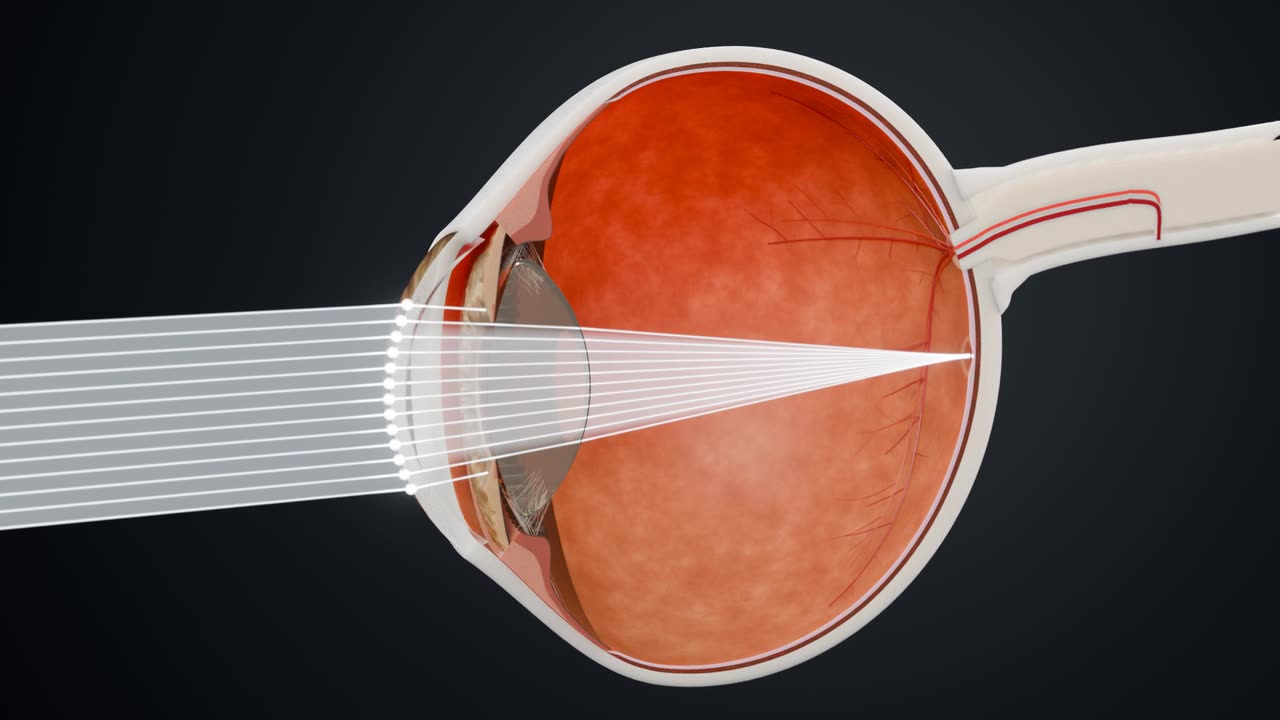
Parallel rays bend at the cornea and lens to focus on the fovea, the camera pushes in as the eyeball lengthens 2 mm so the focus falls short and blurs, then a concave spectacle lens glides in along the axis, spreads the beam, and the blur collapses back to a sharp point.
Sources
- Le Grand and El Hage, Physiological Optics
- Atchison and Smith, Optics of the Human Eye
Rendered in Blender Cycles from code: geometry, materials and motion.
Exaggerated or simplified
- The spectacle sits 60 mm in front of the eye with -7.08 D of power instead of a real 12 mm and -4.5 D, because the real lens spreads the beam by only about 0.3 degrees, too little to see; the correction itself is exact.
- Every refracting surface is a sphere and the lens has one uniform index, so spherical aberration is somewhat stronger than in a real eye.
- The ray trace runs in a single plane, and the cut-away fluids keep their shape as a clear liquid with a flat cut face.
- The cut is the horizontal plane through the fovea and optic disc, presented like a side-on cut-away.