A rendered film. The scene that rendered it comes with Pro or Lifetime.
Cochlea and hearing
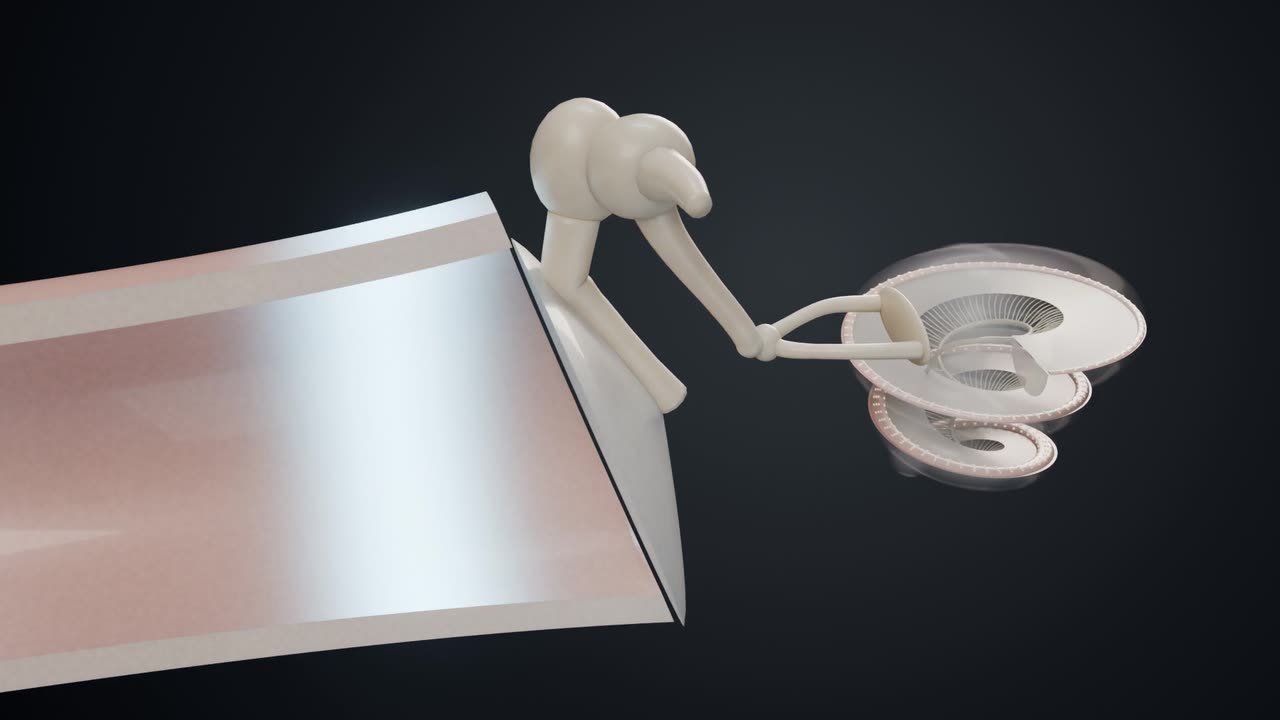
A 1 kHz tone travels down the ear canal and rocks the eardrum and ossicles, the stapes pumps the oval window, the cochlea uncoils into a straight duct where a travelling wave peaks about 21 mm from the base, and the camera pushes in on hair cells there tipping and firing in step with the membrane.
Sources
- Greenwood 1990 (place-frequency map)
- Pickles, An Introduction to the Physiology of Hearing
- Dallos 1996
- von Békésy (travelling wave)
- Robles and Ruggero 2001
Rendered in Blender Cycles from code: geometry, materials and motion.
Exaggerated or simplified
- Time is slowed about 500 times, so the 1 kHz tone plays at 2 cycles per second, and every movement is hugely enlarged: real eardrum and membrane motion is measured in nanometres.
- Uncoiling the cochlea is a teaching device, and the uncoiled duct is drawn 3 times wider than life so its wave can be seen.
- The sound bands in the canal are 13 mm apart, where a real 1 kHz wavelength in air is 34 cm.
- Hair cells are representative, one group every 0.25 mm instead of about every 10 µm and each about 5 times life size; the tectorial membrane, supporting cells, tip links, outer-hair-cell amplification and the balance canals are left out.
- Nerve fibres are drawn beside the uncoiled duct instead of running down the core of the cochlea.