A rendered film. The scene that rendered it comes with Pro or Lifetime.
Diamond and graphite
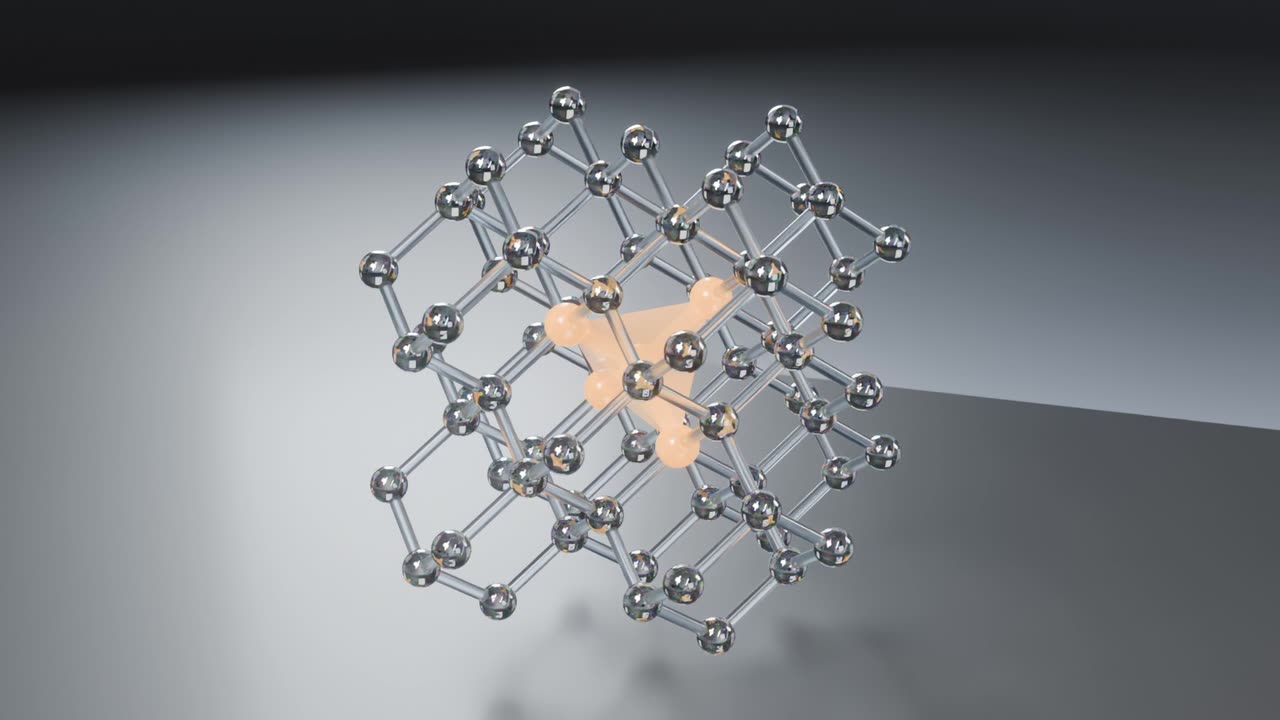
A ball-and-stick diamond cluster turns as one body while one atom, its four bonds and a tetrahedron light up, then the camera moves to a graphite stack where one atom's three bonds and a triangle show the flat geometry, and the top two sheets slide sideways.
Sources
- Kittel, Introduction to Solid State Physics, chapter 1
- Greenwood and Earnshaw, Chemistry of the Elements, chapter 8
- Bernal (1924), Proceedings of the Royal Society A 106, 749
- Standard gemmological tables (diamond refractive indices)
Rendered in Blender Cycles from code: geometry, materials and motion.
Exaggerated or simplified
- Atoms and bonds are drawn at sizes chosen for legibility, not their physical radii; bond lengths, angles and layer spacings are exact.
- Real graphite is opaque grey-black; here it is smoky dark glass so it reads as a different material next to clear diamond, and the glass bonds and orange glow are a visual code.
- Real shear is driven by applied stress and passes through intermediate stackings; here two sheets glide smoothly at constant height, so the motion is right in kind but its timing is illustrative.
- Both pieces are tiny patches about a nanometre across, with cut edges and no hydrogen atoms drawn on them.