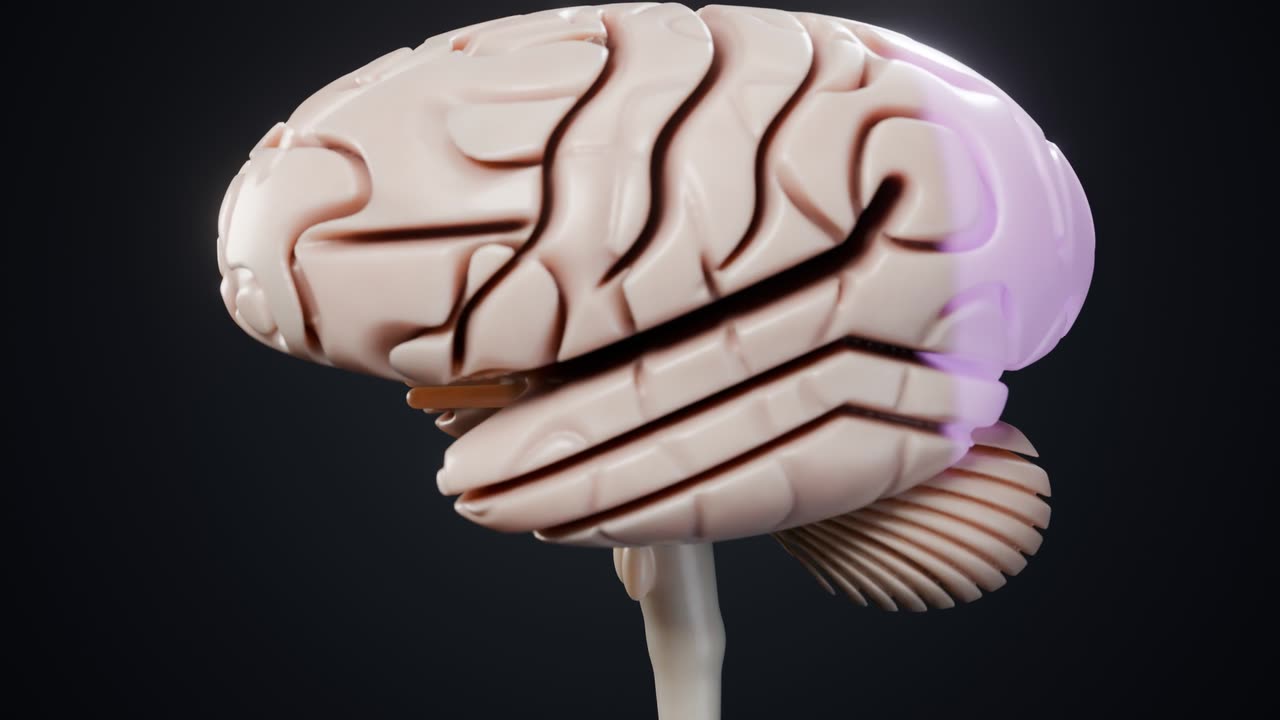
A rendered film. The scene that rendered it comes with Pro or Lifetime.
Brain regions
Seen from the left, the four lobes of a brain light up one after another followed by the cerebellum and brainstem, then the left half lifts out of frame to reveal the midline section, where the corpus callosum and thalamus glow and the hippocampus shows through a fading window in the tissue.
Sources
- Gray's Anatomy, 41st edition, neuroanatomy chapters
- Duvernoy, The Human Brain, 2nd edition
- Duvernoy, The Human Hippocampus
- Ono, Kubik and Abernathey, Atlas of the Cerebral Sulci
- Talairach and Tournoux, 1988 (midline proportions)
Rendered in Blender Cycles from code: geometry, materials and motion.
Exaggerated or simplified
- The grooves of the brain are shallower than real, the smaller ones follow a generated pattern rather than a specific brain, and both halves share the same main pattern.
- The cerebellum's folds are spaced about twice as wide as real so they read at this size, and its white-matter tree is shading on the cut face, not a separate model.
- The hippocampus is shown through the tissue in an x-ray fade; it is not in the midline plane, so the shot shows where it sits rather than a cut through it.
- Meninges, vessels, most cranial nerves, the insula, the pituitary and the lateral ventricles are left out, and the lobe colours are for teaching, not anatomy.