A rendered film. The scene that rendered it comes with Pro or Lifetime.
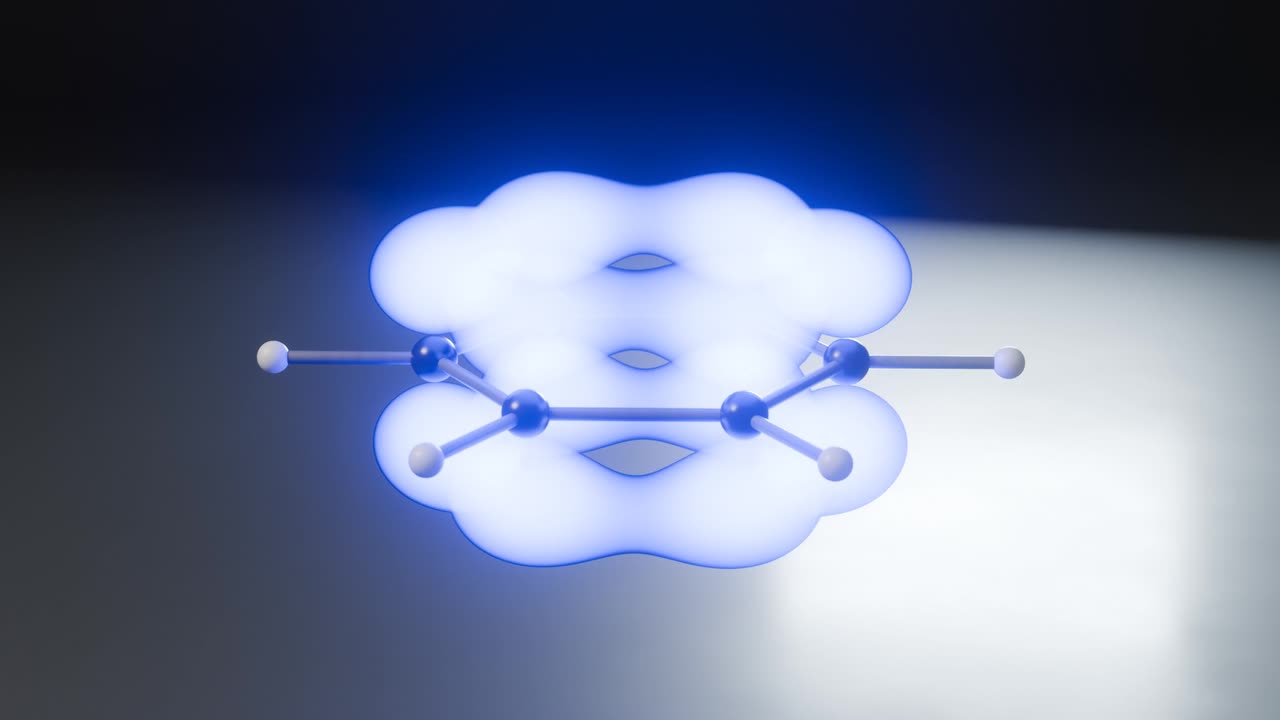
Benzene π system
The twelve atoms of benzene fly in and bond, six carbon p orbitals extrude as separate dumbbells, then merge into two glowing pi rings above and below the ring while the camera orbits and descends to a side view of the empty nodal plane.
Sources
- Atkins, Physical Chemistry (Hückel treatment of benzene)
- Streitwieser, Molecular Orbital Theory for Organic Chemists
- Clayden, Organic Chemistry, chapter 7
Rendered in Blender Cycles from code: geometry, materials and motion.
Exaggerated or simplified
- The orbitals use a more diffuse exponent than Slater's rules give (1.2 instead of 1.625), so that one density contour can show separate dumbbells, continuous rings and an open hole in the middle; with the standard value no single contour does all three.
- The density comes from a simple Hückel model, not a full quantum chemistry calculation, so the rings bulge over each carbon.
- The orbitals extruding is animation, and the glow and its colour are a visual code for a static electron density.
- Atoms and bonds are small ball-and-stick spheres, far smaller than the atoms' real size, so they stay inside the nodal band.