A rendered film. The scene that rendered it comes with Pro or Lifetime.
Bohr atom to quantum atom
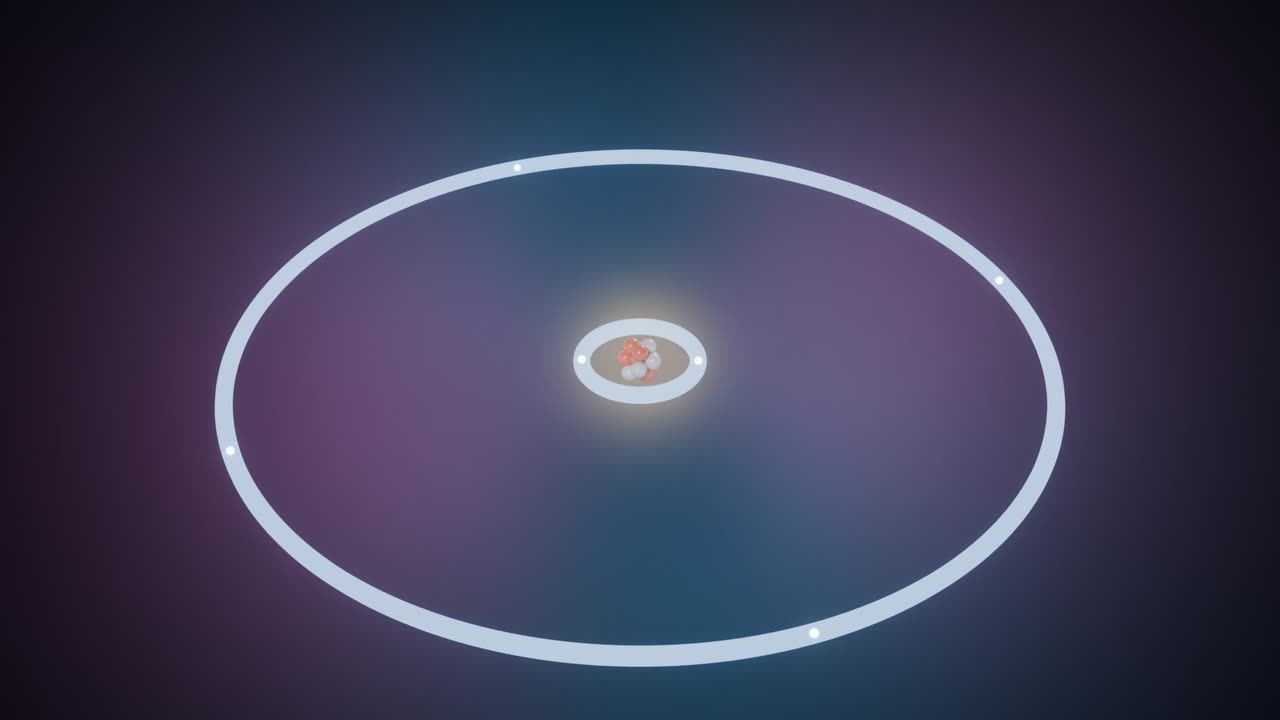
The camera pulls back from a carbon-12 nucleus to show six electrons on two Bohr orbits, then the orbits fade into quantum probability clouds peaking at the same radii (a bright 1s, a cut-away 2s and two 2p dumbbells) as the camera rises over the atom.
Sources
- Slater, Physical Review 36, 57 (1930), screening rules
- Clementi and Raimondi, Journal of Chemical Physics 38, 2686 (1963), carbon orbital exponents
- Angeli and Marinova (2013), carbon-12 charge radius
Rendered in Blender Cycles from code: geometry, materials and motion.
Exaggerated or simplified
- The nucleus is drawn about 1,300 times too big; at true scale it is about 1/100,000 the size of the atom.
- The Bohr orbits are shown as history: electrons do not follow orbits, and the orbital speeds are slowed enormously, with the inner-to-outer speed ratio compressed.
- Cloud brightness is tone-mapped per orbital, so relative brightness between orbitals is not to scale, and the colours are labels; orbitals have no colour and the sign of the p lobes is not shown.
- The 2s wedge cutaway is a visualisation device, and the orbitals are Slater approximations, right to about 10 to 20 % of more exact calculations.