A rendered film. The scene that rendered it comes with Pro or Lifetime.
Lungs and gas exchange
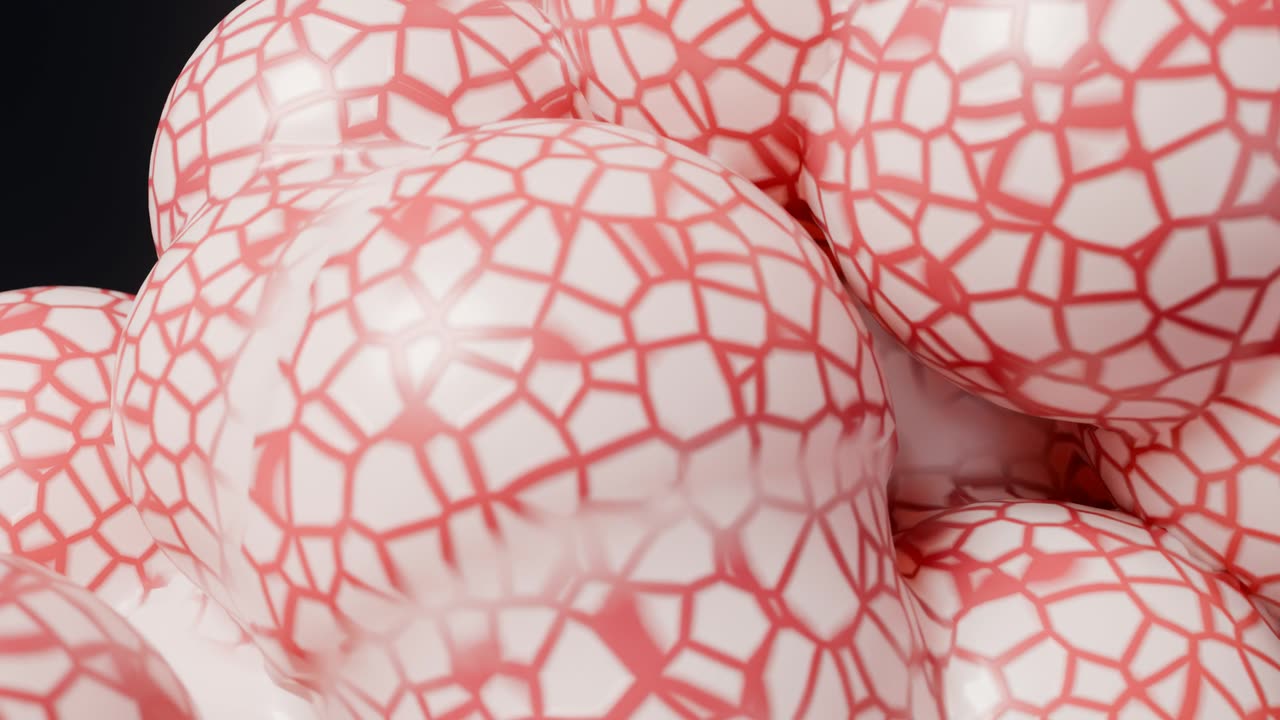
The camera pushes into a breathing bronchial tree, dissolves to a cluster of alveoli in a capillary net that inflate with the breath, then dissolves to a section through the blood-air barrier where red cells flow past, take up oxygen and turn scarlet while carbon dioxide leaves into the air.
Sources
- Weibel, Morphometry of the Human Lung, 1963
- Ochs et al., American Journal of Respiratory and Critical Care Medicine, 2004 (number of alveoli)
- Weibel, 1973 (blood-air barrier)
- Gehr et al., 1978 (blood-air barrier)
- Evans and Fung, 1972 (red cell shape)
Rendered in Blender Cycles from code: geometry, materials and motion.
Exaggerated or simplified
- The airway tree has about 10 to 12 generations instead of 23, and the three scales are separate models joined by dissolves, not one continuous zoom.
- The alveoli are the textbook bunch of grapes rather than the real packed sponge with shared walls, and the capillaries are drawn as a net on the outside instead of running inside the walls.
- The alveoli stretch a little more than in quiet breathing, and the red cells move about 400 times slower than real.
- Gas molecules are drawn about 700 times too large, and the colours are conventions: oxygen cyan, carbon dioxide amber, the arteriole blue and the venule red, though real deoxygenated blood is dark red, not blue.